A 3-step guide for getting data on women writers from the German National Library

Since what feels like an eternity I have been frustrated and fascinated with the gender gap in translated fiction. I found that there are very few datasets and tools to make women writers of German fiction and their roles in book history visible (read more about what the gender gap looks like in my last article). Here is my attempt to make existing resources a tiny bit more accessible to other curious scholars and students.
To date, finding women writers in most national collections still requires extra steps. There is no extra button or search option to filter library entries for women authors, translators, or editors. This is why I will briefly walk you through an easy and quick way to get the data we all desperately need to fight the underrepresentation of women in book history.
What is the Gemeinsame Normdatei (GND)?
The authority file or common standard file (GND) is where you can find any and all information on people or institutions in the German, Swiss, and Austrian national library collections. For authors, for example, it includes biographical information such as birth year, places of residence, family, related works, and gender. It is a rich source of data for us, literary scholars, and can be easily accessed with the existing tools.
How does the GND label gender?
In the GND, gender labels are mandatory, meaning that each author record that has a work in the DNB’s collection is labeled as male, female, unknown or with a custom attribute such as “intersex”. Gender labels are recorded in each record’s MARC21 file, in the field 375 (subfield $a). But we won’t get into the perils of MARC21 files here...
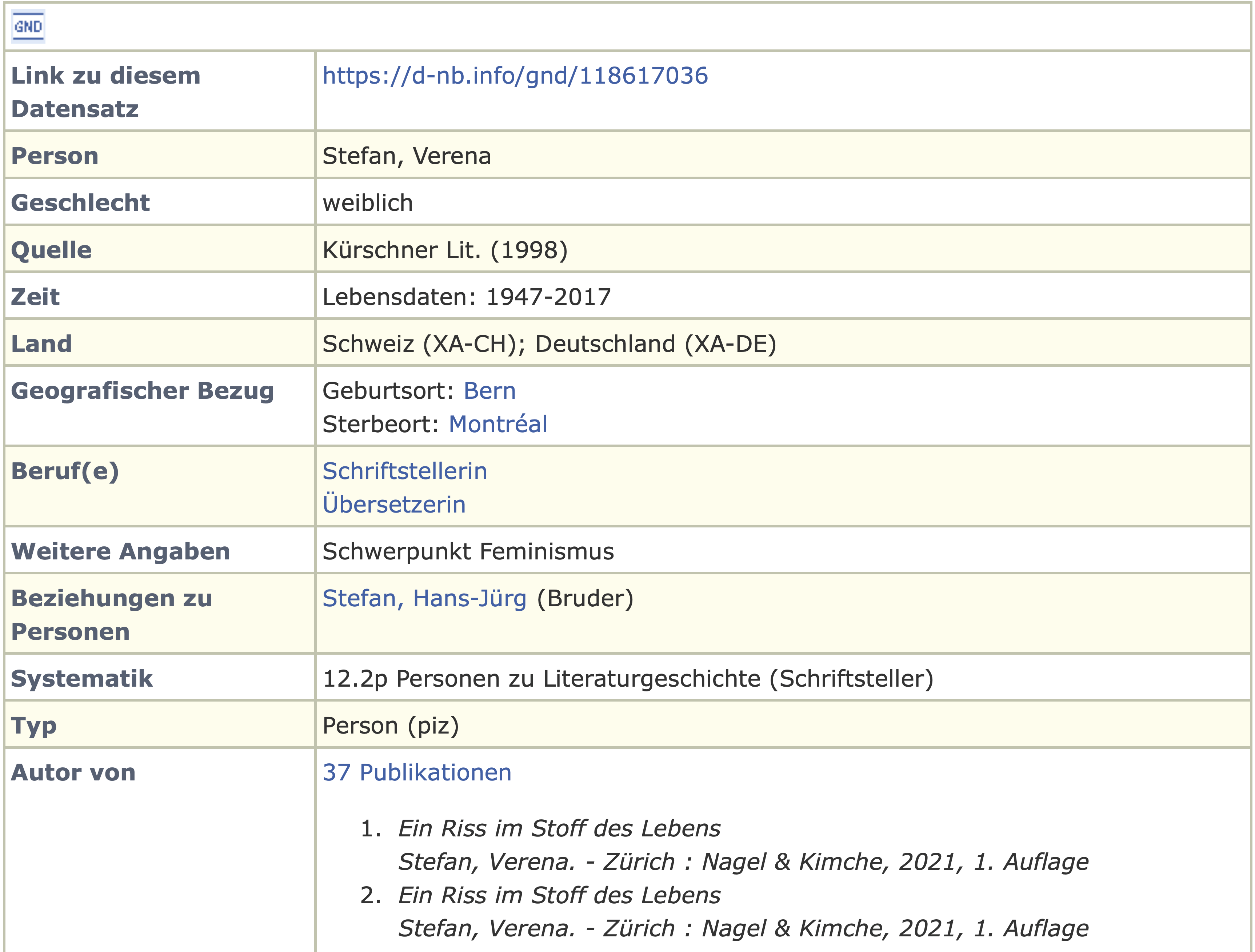
It is still debated to what extent the current definition of gender is appropriate and inclusive. The DNB, for instance, still uses the term “Geschlecht”=Sexus according to a dictionary definition from 1999. The former director of the gender library (Genderbibliothek) in Berlin Karin Alexander has been challenging cataloguing standards and calling for the use of “Gender” instead of “Geschlecht”. It is also important to note that the use of labels beyond the binary is still rare and understudied (in my “Mapping German fiction in translation” dataset, for example, I had 0 entries for other labels that “male” and “female”). As scholars working with this data, we have a responsibility to account for these practices and become active members in the debate on their usefulness and accuracy.
How can we find women writers by using the GND’s gender labels?
Thankfully, the DNB has a brand-new service that lets you easily browse and extract bibliographic records in table format from the German National Bibliography and the GND (Gemeinsame Normdatei). In their brand-new SPARQL service (BETA version), we can easily filter all records for authors with the GND gender tag “female” (https://d-nb.info/standards/vocab/gnd/gender#female). Here are the sreps:
Just copy-paste the following link in your browser of choice (Google or Mozilla work best in my experience):
https://sparql.dnb.de/dnbgnd/FfEL8W
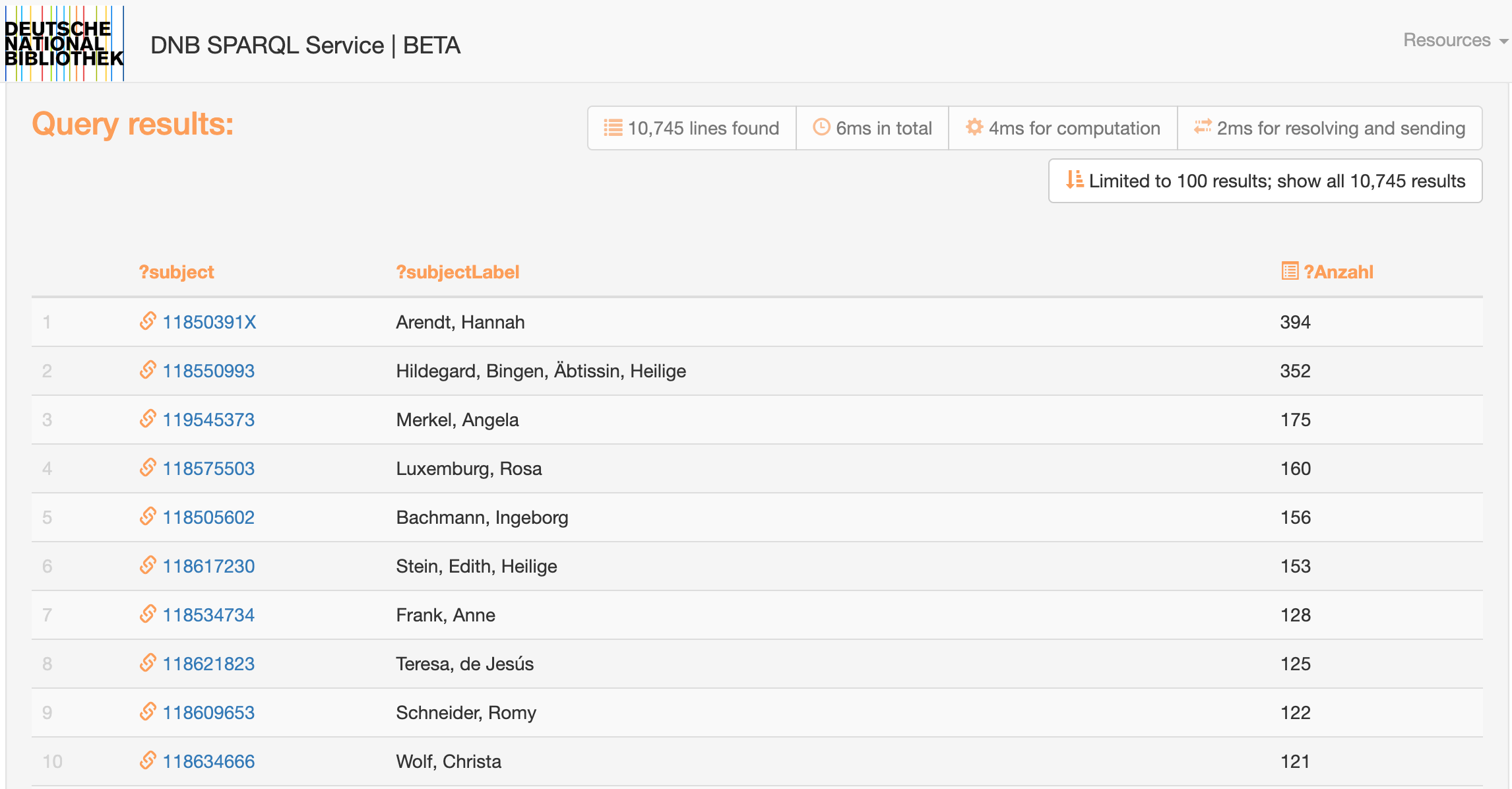
After pressing on “Execute”, we should get a table of female people and the number of their editions in the DNB’s collection. We can then export the result as a CSV and start analyzing!
What can I do now?
Visualize the most prominent women writers with a simple bargraph
If you know R, feel free to adapt one of my scripts:
Fabulous idea.